
Growing up is hard (I know, what a hot-take). In the 21st century growing up feels less like a pre-determined, confined pathway and more like a kind of unending liminal state – limbo.
The pandemic drags on in ways that we could never have expected where the ‘new normal’ is just the same days spent in similar ways. There is the terrifying carousel of news stories of human rights abuses – domestic and international – as we know more than we perhaps have ever about horrors such as the treatment of Uyghurs in Xianjiang and the waning liberty of Hong Kong, police brutality, and the recent fall of Afghanistan to the Taliban.
The ‘horror’ of modern maturation does not come from a lack of freedom in a predetermined life. The ‘horror’ emerges from helplessness and apathy as the world seems to just become a more terrifying, insurmountable, and unfeeling place. And the waiting. All the fucking waiting…
Am I right? Maybe that is just me. I might be projecting. Anyway!
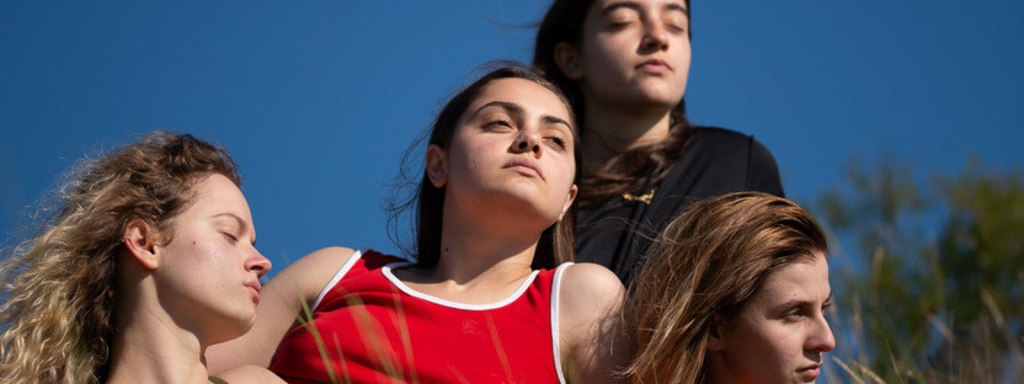
The Hill Where Lionesses Roar is the directorial debut of 20-year old Luàna Bajrama, perhaps best known for her on screen role in Portrait of a Lady on Fire. The film, set in a small village in Kosovo, follows three young women (Jetta, Li, and Qe) as they navigate their post-adolescent lives; poor, lost, aimless, and frustrated. It is a coming-of-age story that resembles those of the past, as the protagonists yearn for the opportunity to break from abusive caretakers, generational poverty and cloistering familial expectations.
And yet the most compelling element of the film is how its protagonists enact the ‘coming of age’ narrative. For the most part, they wait. Circumstances do not allow them to act their way out of their situations. Their narrative cannot be the same as the archetypal coming-of-age protagonist that has the means develop engage in the life they dream, but that doesn’t have the know-how or motivation. Jetta, Li and Qe are trapped, hopeless. All they can do is wait.
In the film this takes the form of an extended first-third – which accounts for around half of the film’s runtime – in which the women literally wait to be admitted into university. In this section of the film, the setting of Kosovo comes to prominence. The landscape is sparse, filled with bright greens and dark earth, flat tree-less plains and the titular hills which surround the village. The distinctive elements of the environment serve both as a gorgeous backdrop, as well as a reminder of the inescapability of the town. Routinely reinforced by the film’s consistent use of landscape shots, in the beauty of the landscape there is the terrible reminder that nothing waits for them outside of the village.
And yet, while there is an inexorable hopelessness to their situation, Jetta, Li and Qe find ways to enact little moments of rebellion. The latter half of the film has a bitter-sweet tone, as the girls seek saviour from their situation in friendship and escapism. Roleplaying as famous criminals – while committing real crimes – Jetta, Li and Qe find a certain solace in sisterhood, isolation and performing what agency they feel they have left. The waiting doesn’t go away, but how that time is spent does: the protagonists becoming mobile agents in the space.
The start of the 2020’s in Australia has as of yet been a practice of our patience and our comfort with immobility, seclusion and confined self-determination. The horror of waiting is inescapable. But perhaps there is a certain solace to be found in how we determine our time spent waiting.
 No One's Opinion
Leave a comment