

As a mid-twenty something severely lacking in the virtue of shit-togetherness, children terrify me. Little chaotic balls of energy that are unpredictable, sticky, smelly, loud. Perhaps my perspective was somewhat negatively skewed by my last few years working in the hospitality industry. I was a waiter and host for a bar that had an inbuilt playground – a recipe for destruction, burst eardrums, and what must have been some very unromantic midweek dates for couples. Perhaps I am not the best person to ask about the virtues of parenthood.
But watching Scottish director Lynne Ramsey’s 2011 masterpiece We Need to Talk About Kevin, I feel very confident in my current childless state. The film follows Eva (played by Tilda Swinton) two years after her son, Kevin, committed a horrific, murderous act at his high school. Eva attempts to move on with her life and come to terms with the actions of her son.
However, she is unable to do so. She is trapped reliving traumatic memories of Kevin – a sadistic, cruel child who, seemingly from birth, derived pleasure and purpose in the manipulation and torture of Eva. This is not to say that Eva is a saint. Even in her own memories she is a disaffectionate mother who hides a desire to be anything but a parent behind a thin veneer of superficial nicety.
The narrative of the film, Kevin’s upbringing, takes place in flashbacks. The events of the film are from the character of Eva’s perspective. The flashbacks are her memories – subjective and from her point of view. The scenes set in the present-day centre her experiences and mental state after the trauma of her past. As such, the film is more so an exploration of Eva’s crumbling mental state than an objective portrayal of the film’s world. The film deals with time very loosely, jumping from past to present, the structure of the film mimicking Eva’s fragmented psyche.
While I love this film, it is Hard (with a capital ‘h’) to watch. The film is contemplative journey through a mind in collapse. The film has the tension of a horror film. Except the horror antagonist is not an external and unknowable figure, but Eva’s child, her own blood. The horror is the home, parentage, and familial obligation. Even though these things no longer exist for Eva in the present, her inability to come to terms with the trauma of her past means that the horror indefinitely persists.
The film is very sensuous. As in it focusses intently on the sense experience of Eva. Not that it is sexy. It is decidedly un-sexy.
Everyday sense experiences such as sight, sound, and touch trigger Eva’s memories of her traumatic past. Eva attributes certain present-day experiences to memories of specific eras of Kevin’s development. Initially, Eva’s memories are triggered by loud noises such as jackhammers of construction sites. Such loud, abrasive noises cause her to recollect Kevin as a baby who never stopped crying. Experiences of touch, such as that of her imprisoned son’s arm, later function as the trigger for memories of Kevin as a vindictive 6-to-8-year-old. Lastly, visual sense experiences trigger memories of Kevin’s dark, violent teenage years.
This is all exceedingly interesting, and there is much that could be discussed with regards to how the film portrays memories as connected to the tactile sense experiences of the present. But I am not going to do that. I am the master of my own destiny. Don’t tell me what to do. You aren’t my real dad.
Instead, I am going to discuss one specific (genius) palette choice that I think has a profound effect on viewer. Let’s look at how the film uses a specific shade of red to represent the connective tissue that links the past to the present, and the present to the past in Eva’s fractured psyche.
What shade of red, you say?
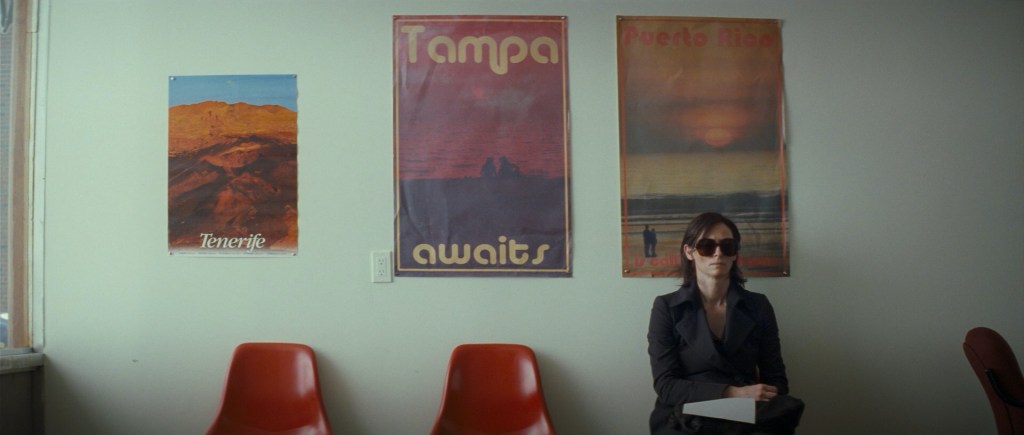
The colour of these red chairs:
Or this red ball:

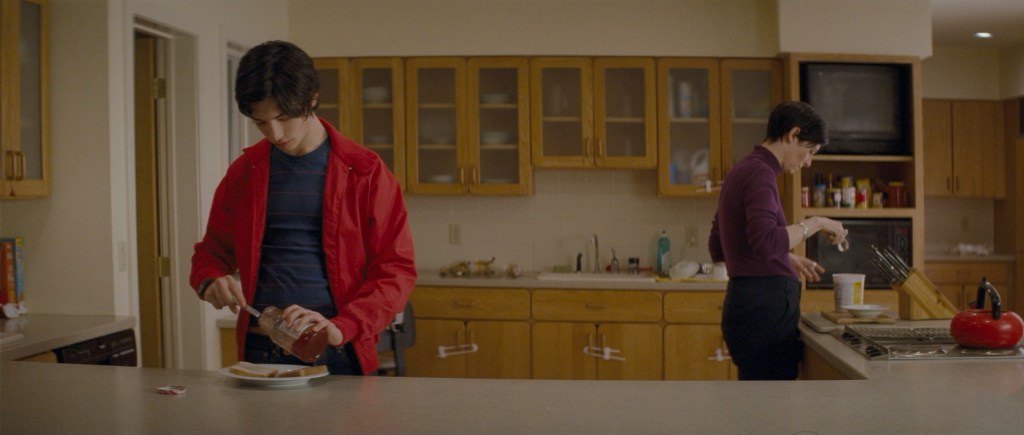
Or this red jacket and kettle:
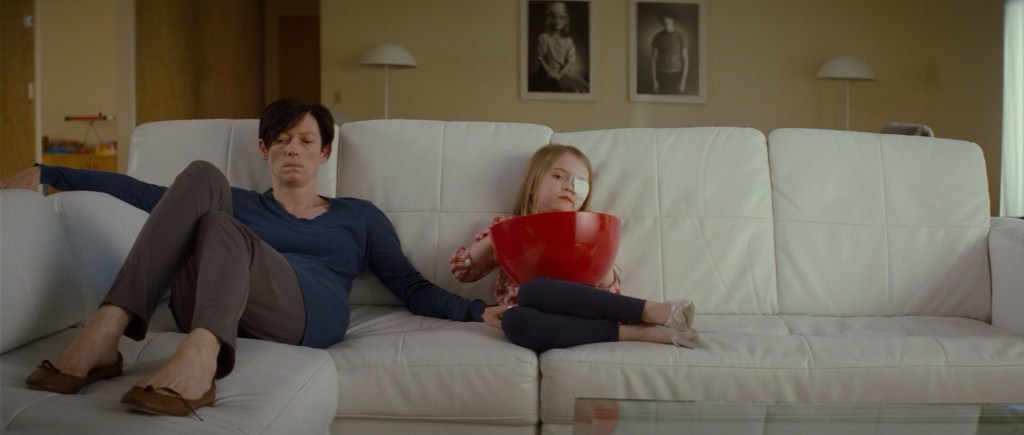
Or this red bowl:
Or this red paint graffiti:

Or this red lighting:
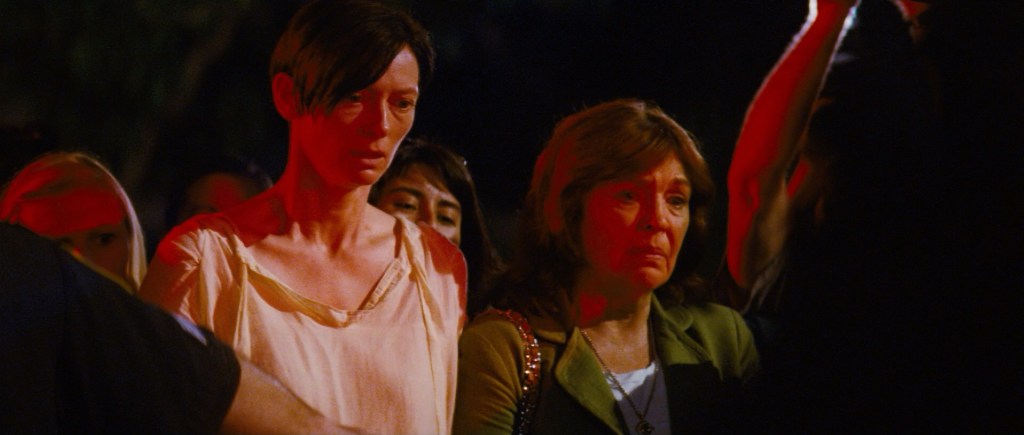
Or this red lighting:
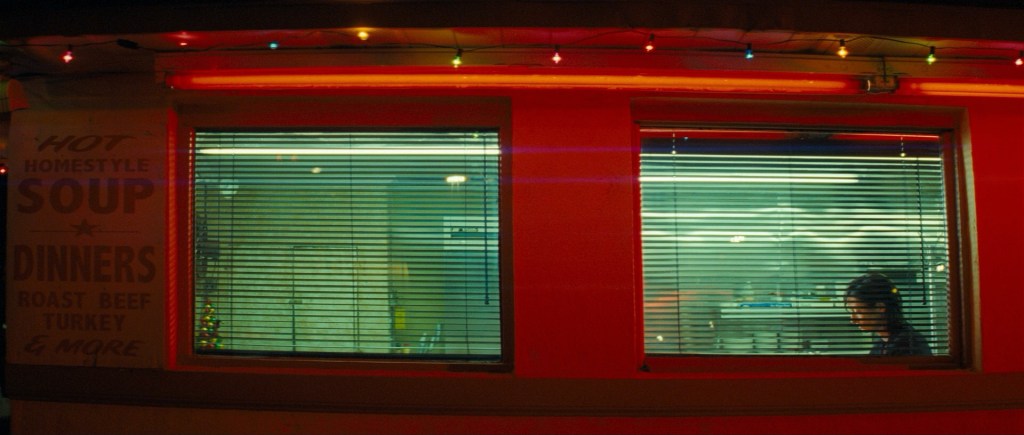
Or THIS red lighting:
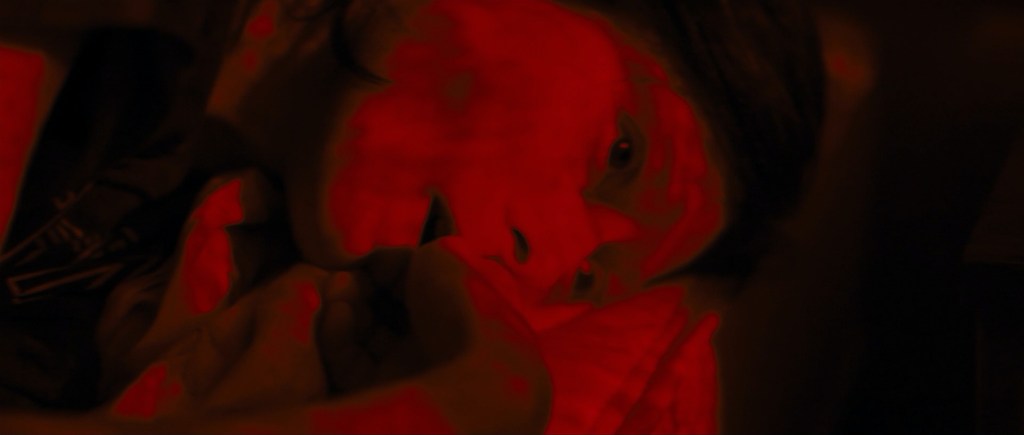
This red is included in some form in almost every scene of the film – the red paint vandalism of Eva’s house and car, red cups, red elevator buttons, red exit signs, red digital alarm clock numbers, red trees, red chairs, red Campbell soup cans, red lighting. Red, red, red. And all approximately the same shade.
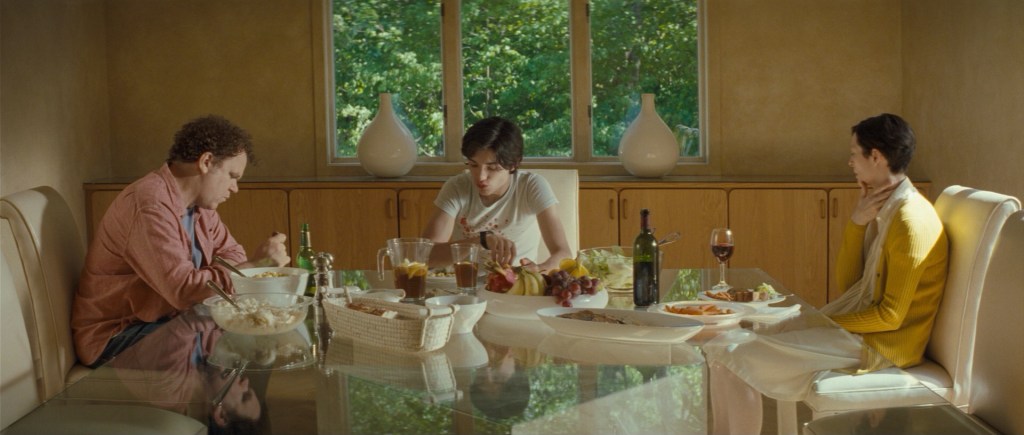
This specific red is an outlier in the palette of the film insofar as it exists in almost every scene – in the flashbacks and the present day. The film’s palette changes significantly with the shift from present day to the past. Scenes that flashback to the past have a warm palette – made up of oranges, yellows, and natural wood tones:
On the other hand, the scenes that take place in the present day have a cool palette – constituted of light blues, greys, and cool off-whites:
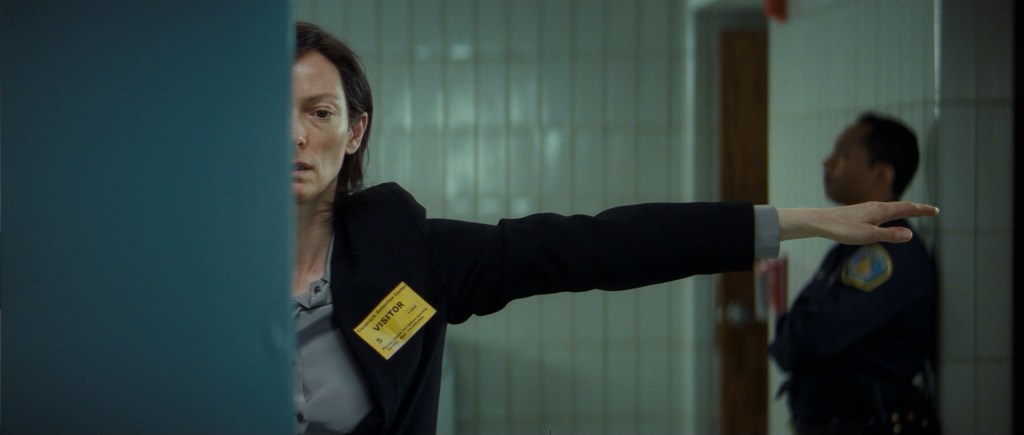
And yet, that specific shade of red is everywhere throughout the film and remains arrestingly bright and distinct compared to the general palettes of the present and past. It is the only visual element that is carried from present day to the flashbacks without alterations. Even Eva shifts appearance dramatically – having short hair and dressing well in her memories and having long unkempt hair and daggy clothing in the present. This red is what visually connects the past to the present for the audience throughout the film. This red’s distinctive omnipresence in the film’s environments establishes the colour as a signifier of the psychological sinews that connect past to present in Eva’s psyche.
So, if this specific red acts as bridge between Eva’s past and present, what does it represent? The specific red that is ever present in Eva’s perspective of events has its roots in the atrocity Kevin committed at his school. The flashbacks that recall this tragedy are numerous and occur throughout the film. During her memories of this day, Eva is inundated by the red. It appears in the red sirens of the police, the red doors to the school, and the spilled blood of her family.
As such, this red is a signifier of the trauma wrought by Kevin, and the lasting effect of his terrible actions. This red, and in turn this event, surrounds Eva, both in her recollections of the past and her experience of the present. Even memories that do not include Kevin are reflexively coloured red. This red occupies every corner of Eva’s mind, even those that ostensibly should exist without Kevin’s impact. Her trauma isn’t relegated to her memories. It is an essential part of how she perceives the world. Her perception of the past and present is, quite literally, coloured by Kevin and his sadistic and murderous actions.
By the end of the film, it is apparent that Eva believes all of Kevin’s terrible actions were committed with the intent to punish her. It does not matter if this belief is true or not. For the film’s duration, the audience is occupying Eva’s broken psyche. For Eva’s fractured mind, this is the reality. In a certain sense, the red and all it represents for Eva is a continuation of the punishment wrought by Kevin.
It is a punishment that is central to how she continues to exist in the world. Because of Kevin’s rampage, she lost her husband, her daughter, and her livelihood. It is why the film includes multiple scenes of her visiting him in juvenile detention. It is why at the end of the film it is revealed that she recreated his old room in her new, run-down shack. As horrifying as it is, Kevin is all she has left. He is inescapable, he is blood. Because of his actions, he is inextricable to every aspect of who she is now, and who she views herself to have been over time. The bright red that follows Eva into every scene acts as a signifier of the inseparability of Kevin from Eva’s psyche.

 No One's Opinion
Leave a comment